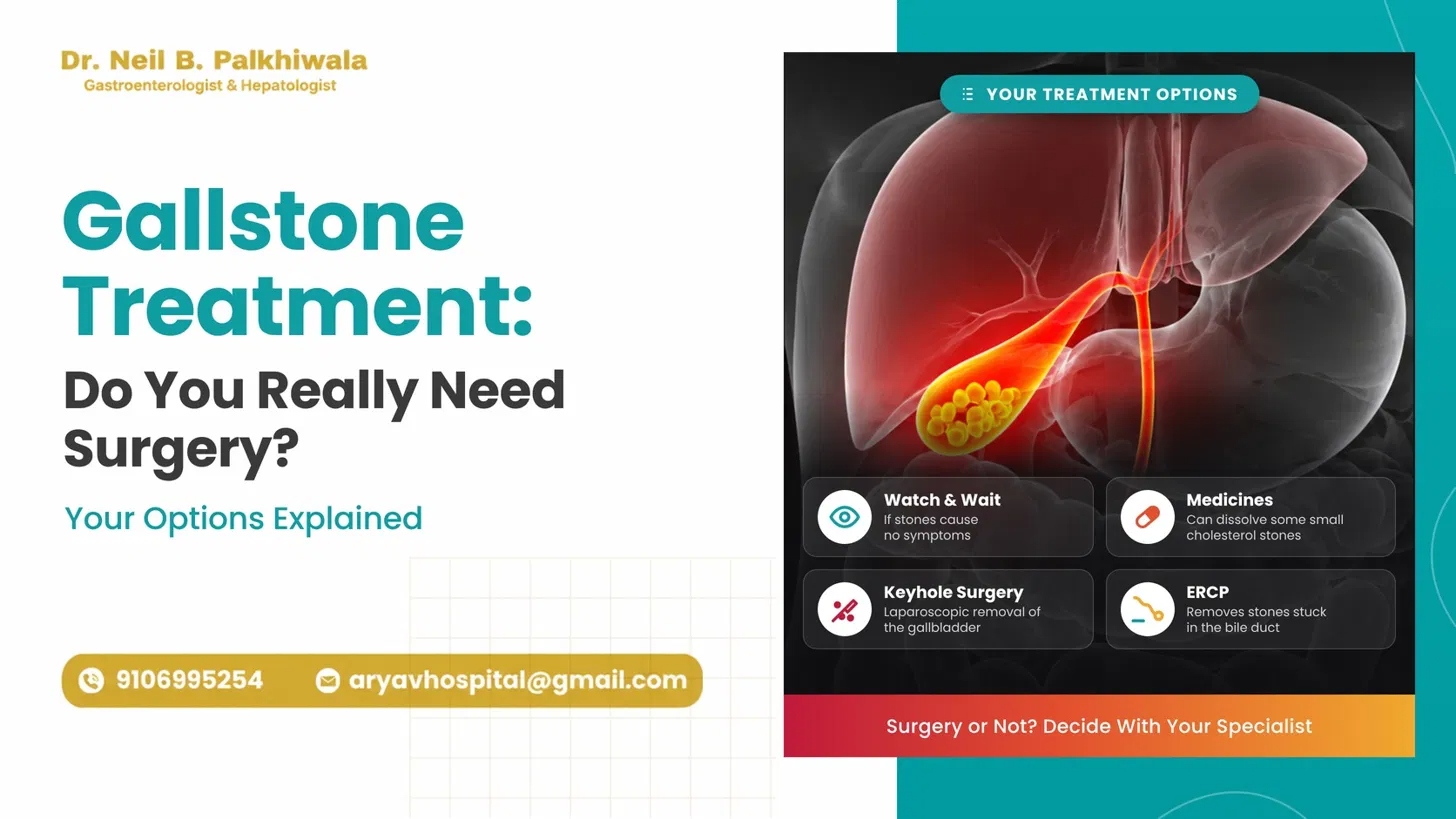
Gallstone Treatment: Do You Really Need Surgery? Your Options Explained
You went for an ultrasound for something else—maybe chronic acidity, gas, or a routine health check-up—and the sonography report says “cholelithiasis” or “multiple gallbladder calculi / stones.” Suddenly you have a flood of urgent questions: Will these stones dissolve? Do I definitely need an operation? Can I live a normal life without my gallbladder? Are those online “liver detox” or lemon-oil flushes worth trying?
You are not alone. Gallstones are among the most common digestive disorders encountered in clinical practice, and confusion regarding gallstone treatment is just as widespread.
This evidence-based guide explains your medical and surgical options in plain language: when watchful waiting is safe, when definitive intervention is essential, what modern procedures like ERCP and laparoscopic cholecystectomy actually involve, and what your digestion looks like afterwards.
First, a Quick Refresher: What Are Gallstones?
The gallbladder is a small, pear-shaped reservoir situated directly beneath the liver. Its primary function is to store and concentrate bile—a golden-green digestive liquid synthesized by the liver to emulsify and absorb dietary fats. When you eat a meal, the gallbladder contracts and propels bile through the cystic and common bile ducts into the duodenum (small intestine).
Gallstones develop when chemical imbalances cause constituents in bile—chiefly cholesterol or bilirubin—to precipitate and crystallize into hard, pebble-like deposits. They range in size from tiny grains of sand to large marble-sized stones, and patients may form a single solitary stone or dozens of calculi.
Two Primary Stone Types:
- Cholesterol Stones: Accounting for over 80% of cases, these yellowish-green stones form when the liver excretes more cholesterol than bile salts can hold in solution. Strongly linked to metabolic factors, visceral weight, and refined diets.
- Pigment Stones: Dark brown or black stones composed of calcium bilirubinate, more frequently seen in patients with chronic liver cirrhosis, biliary tract infections, or hemolytic blood disorders.
Primary Risk Factors: Excess body weight, rapid crash dieting, diabetes mellitus, pregnancy, oral contraceptives, increasing age, and a genetic family history of gallstones.
The Big Question: Do All Gallstones Need Treatment?
No. The most critical factor determining gallstone treatment is not stone size, shape, or number—it is strictly whether the stones are causing active symptoms or clinical complications.
1. Silent Gallstones (Asymptomatic Stones)
Up to 70% of people with gallstones have "silent" stones uncovered incidentally during routine ultrasounds. For the vast majority of silent stones, medical guidelines recommend watchful waiting (active surveillance) rather than rushing into immediate surgery.
The US National Institute of Diabetes and Digestive and Kidney Diseases (NIDDK – Treatment for Gallstones) emphasizes that asymptomatic stones rarely progress to complications and generally require no surgical removal. Furthermore, an extensive Cochrane Systematic Review demonstrated no evidence that prophylactic gallbladder removal in asymptomatic individuals offers superior clinical outcomes compared to observation.
When Surgery Is Still Advised for Silent Stones:
- Extremely large stones (greater than 3 cm), which carry higher long-term risks.
- A gallbladder packed full of stones with loss of contractility.
- A "porcelain" (calcified) gallbladder wall or concurrent gallbladder polyps larger than 10 mm.
- Patients with poorly controlled diabetes or immunosuppression where acute infections can be life-threatening.
- Frequent travel to remote regions where emergency surgical facilities are unreachable.
2. Symptomatic Gallstones (Causing Pain or Complications)
Once gallstones begin triggering attacks, the probability of recurrent, progressively severe episodes climbs dramatically (over 50% recurrence within a year). At this stage, definitive intervention is strongly advised.
Typical Warning Symptoms (Biliary Colic):
- Sudden, intense cramping pain in the upper right quadrant or epigastrium (middle of upper abdomen).
- Pain radiating towards the right shoulder blade or mid-back.
- Episodes characteristically triggered 30 to 90 minutes following a heavy, oily, or fried meal.
- Nausea, vomiting, and upper abdominal fullness accompanying the pain.
Red-Flag Warning Signs – Seek Immediate Medical Care:
- Abdominal pain persisting continuously for more than 4 to 6 hours.
- High fever with chills and rigors (indicating acute cholecystitis or cholangitis).
- Yellowing of eyes or skin (jaundice) and dark amber urine (indicating a common bile duct blockage).
- Excruciating, band-like abdominal pain radiating straight to the back with severe vomiting (acute gallstone pancreatitis).
How Are Gallstones Accurately Diagnosed?
Before establishing a treatment roadmap, a gastroenterologist evaluates stone location, gallbladder wall thickness, and bile duct patency:
- Abdominal Ultrasonography: The non-invasive, radiation-free gold standard test. Detects gallbladder stones with over 95% sensitivity.
- Liver Function Tests (LFTs) & Pancreatic Enzymes: Elevated bilirubin, alkaline phosphatase (ALP), or elevated serum amylase/lipase alert the doctor to common bile duct stones or secondary pancreatitis.
- MRCP (Magnetic Resonance Cholangiopancreatography): A specialized MRI protocol providing high-resolution 3D visualization of the biliary tree and bile ducts without contrast injections.
- Endoscopic Ultrasound (EUS): Highly sensitive internal endoscopic ultrasound deployed to uncover microscopic bile duct sludge (microlithiasis) missed by conventional imaging.
- Multidetector CT Scan: Evaluates complications such as gallbladder perforation, emphysematous cholecystitis, or peripancreatic fluid collections.
Your Gallstone Treatment Options Explained
1. Watchful Waiting (Surveillance)
The standard, safe protocol for asymptomatic (silent) gallstones. Involves patient education regarding warning symptoms, adopting a low-fat dietary framework, and routine annual follow-ups.
2. Laparoscopic Cholecystectomy (Keyhole Gallbladder Removal)
The definitive gold-standard treatment for symptomatic gallbladder stones worldwide.
- Performed under general anaesthesia through 3 to 4 tiny keyhole incisions (0.5 to 1 cm) on the abdomen using a miniature high-definition camera and micro-instruments.
- The entire diseased gallbladder containing the stones is safely dissected and removed.
- Patients typically walk within hours, go home the next morning, and resume desk work within 5 to 7 days.
Why not remove only the stones? Removing just the stones leaves behind a diseased, stone-forming gallbladder wall. Within months, new stones inevitably reform in over 90% of cases. Removing the organ eliminates recurrence permanently.
3. ERCP for Common Bile Duct (CBD) Stones
When a gallstone slips out of the gallbladder neck and lodges inside the common bile duct, it obstructs bile flow, triggering acute obstructive jaundice, life-threatening bacterial cholangitis, or severe gallstone pancreatitis.
ERCP (Endoscopic Retrograde Cholangiopancreatography) is a specialized non-surgical endoscopic procedure performed through the mouth to clear the bile duct:
- A flexible side-viewing duodenoscope is passed through the mouth and stomach into the small intestine. There are zero cuts on the abdomen.
- The ampulla of Vater (bile duct opening) is gently widened (sphincterotomy).
- Stones are extracted into the intestine using specialized extraction balloons or wire Dormia baskets.
- A temporary plastic or metal biliary stent is placed if residual debris or strictures exist.
The Sequential Approach: ERCP clears the common bile duct, after which the patient undergoes planned laparoscopic cholecystectomy a few days later to remove the gallbladder and eliminate the source of future stones.
4. Oral Dissolution Therapy (Medicines)
Prescription bile acid tablets (Ursodeoxycholic acid / UDCA) can dissolve small, pure cholesterol stones (under 5 mm) in a functioning gallbladder. However, dissolution takes 12 to 24 months, success rates are modest, and stones recur in up to 50% of patients once medication stops. It is strictly reserved for high-risk surgical patients unfit for anaesthesia.
Quick Comparison of Gallstone Treatment Options
| Treatment Option | Best Suited For | Key Clinical Points |
|---|---|---|
| Watchful Waiting | Silent, asymptomatic gallstones | No surgery needed; monitor for pain, jaundice, or fever. |
| Laparoscopic Cholecystectomy | Symptomatic or complicated gallbladder stones | Permanent cure; tiny keyhole incisions; minimal pain; 24-hr discharge. |
| ERCP Endoscopy | Stones lodged in the common bile duct (CBD) | Non-surgical; scope through mouth; clears bile duct without abdominal cuts. |
| Oral Dissolution Therapy | Selected small cholesterol stones in unfit surgical candidates | Takes 1–2 years; modest success; high recurrence rate after stopping. |
Common Myths About Gallstone Treatment
Myth 1: "Gallbladder flushes dissolve stones."
Fact: Consuming olive oil, apple juice, or Epsom salts does not dissolve gallstones. The green clumps seen in stool afterwards are saponified oil complexes formed in the intestine, not gallstones. Delaying medical care risks acute pancreatitis.
Myth 2: "Removing the gallbladder ruins digestion."
Fact: The liver produces bile, not the gallbladder. Following removal, bile simply trickles directly from the liver into the intestine. Over 95% of patients eat completely normal diets post-recovery.
Myth 3: "If pain stops, the problem is gone."
Fact: Biliary pain settles when a stone temporarily drops back into the gallbladder lumen. The underlying anatomical problem persists, and subsequent attacks are usually more severe.
Myth 4: "Small gallstones are harmless."
Fact: Small stones (2 to 5 mm) are clinically the most dangerous because they can easily slip into the narrow common bile duct, triggering obstructive jaundice and acute pancreatitis.
Life After Gallbladder Removal: What to Expect
Recovery following laparoscopic keyhole surgery is remarkably rapid:
- First Few Days: Stick to light, easily digestible meals (khichdi, oats, dal, curd, clear soups).
- Smaller, Frequent Portions: Eat 4 to 5 small meals daily rather than 2 very heavy feasts.
- Reintroduce Fats Slowly: In the initial 2 to 4 weeks, high-fat meals may cause mild loose stools. Digestive enzymes adapt steadily.
- Fibre Optimization: Gradually incorporate seasonal fruits, oats, and vegetables to maintain regular bowel motility.
- Return to Work: Most desk professionals resume normal routines within 5 to 7 days, with light walking encouraged immediately.
Can Gallstones Be Prevented?
While non-modifiable risks like genetics and age exist, you can significantly diminish your gallstone risk:
- Maintain steady, gradual weight control: Avoid drastic crash diets and rapid starvation weight loss, which surge cholesterol precipitation in bile.
- Adopt a high-fibre nutritional pattern: Emphasize whole grains, legumes, oats, nuts, and fresh vegetables.
- Limit saturated fats and refined sugars: Cut back on bakery items, fried street savouries, and trans-fats.
- Never skip regular meals: Prolonged fasting leaves bile stagnant inside the gallbladder for hours, accelerating crystallization.
- Engage in regular physical exercise: At least 150 minutes of weekly aerobic exercise stimulates gallbladder contractility.

Expert Gallstone & Biliary Care by Dr. Neil Palkhiwala
MD, DM, MRCP SCE (UK) | Senior Consultant Gastroenterologist, Hepatologist & Advanced Endoscopist
With extensive clinical expertise in diagnosing complex biliary disorders, performing scarless ERCP stone extractions, and guiding individualized surgical decisions, Dr. Neil Palkhiwala ensures patients receive accurate, complication-free care at Aryav Super Speciality Hospital, Science City Road, Sola, Ahmedabad.
Book Consultation +91 91069 95254Frequently Asked Questions
The Bottom Line
Finding gallbladder stones on an ultrasound report does not automatically mean an immediate rush to the operating theatre. The appropriate gallstone treatment depends on your symptoms, stone location, and clinical risk profile:
- Silent stones: Frequently require simple watchful waiting and healthy dietary moderation.
- Painful stones: Best definitively cured with minimally invasive keyhole gallbladder removal.
- Bile duct stones: Safely cleared non-surgically with advanced ERCP endoscopy.
A timely specialist evaluation protects you from both unnecessary surgery and dangerous complication delays.
Found Gallbladder Stones on Your Report?
Don't guess between surgery and waiting. Consult Dr. Neil Palkhiwala, leading Gastroenterologist & Endoscopist in Ahmedabad, for a clear clinical assessment and personalized care plan.
Book Consultation Call +91 91069 95254